среда, 11 февраля 2015 г.

11 Insights into (strategic) crisis management

11 Insights into (strategic) crisis management

Executive director COT, instituut voor veiligheids- en crisismanagement

Marco Zannoni & Dora Horjus
"Bad companies are destroyed by crisis. Good companies survive them. Great companies are improved by them” (Andy Grove, former CEO of Intel).
This quote touches the very core of crisis management. Crisis situations can determine the continued existence and the (new) future of organisations. We set out the 11 most important tips for good crisis management.
1. Build crisis capability Being prepared for crisis is a choice. It
is precisely those companies who have everything in order that
invest in crisis management. They know how resilient or well-prepared their organisation is in terms of leadership, decision-making under pressure
and situational awareness. Training and exercises focus on what is not available in the organisation and enhance what is.
2. Take the lead Leadership starts before a crisis. By encouraging a culture in which mistakes can be reported, malpractice is addressed and (near) misses are
actively monitored and learned from. In times of crisis, the crisis operation needs calm and determined leadership. Leadership creates trust and provides clear directions for people. This is what is important to us now and how we will get
ourselves out of this situation.
3. Start with a diagnosis Any approach to a crisis should start with a razor-sharp diagnosis. What’s (really) going on? What crisis are we managing and what is the seriousness of the situation? This means you have insight into the facts, the parties, the impact being experienced and the factors and people complicating or simplifying the situation. This has to be a shared picture of the situation so that you
don’t have one team member managing a technical incident while another sees it as a sector-wide crisis.
4. Deciding in times of uncertainty Critical decisions can escalate or de-escalate a situation. For example, the closure of branches, the resignation of top management and the payment of claims. Critical decisions are rare, always have major consequences and are usually a case of ‘choosing between two evils’. They can only be taken properly if you are aware of the (often controversial) options and the impact of your decision on all stakeholders. Don’t forget to pay attention to critical decisions that may be taken by others (authorities, investors, etc.).
5. Focus on impact What impact is the crisis having on those directly involved and for the organisation itself? These are the two key questions to be examined. How is the situation affecting your license to operate? How can you retain it? And how can you help those directly involved? Take measures to reduce or even avoid the impact in the short and long term.
6. Discover the special nature Each crisis has its own characteristics: a slow or speedy progress, the involvement of authorities and the high or low knowledge of the issues. It is important that you have an eye for the specific nature. This is not an easy search process. Start with what you have prepared or with what you have in-house like procedures, plans, knowledge & expertise within the organisation. As a crisis leader remember to look at what is really needed to manage the special nature of the particular situation.
7. See the situation as it is Organisations who have a common practice of monitoring and setting guidelines have an advantage in times of crisis. Monitoring should be active, arranged and disciplined. A media analysis is a good starting point. Enhance this with stakeholders’ reactions (customer care centres, supervisory bodies and signals from within the organisation). Take good account of the ‘game changers’ (for example proof of foul play) and the actions of influential stakeholders.
8. Work as a team Any crisis managed unilaterally by lawyers, technicians or for example communication professionals is doomed to go wrong. Success needs the integral approach of these disciplines. Set up a multi-disciplinary team under your leadership. This team will act based on the same situational picture, the same leading principles and the same priorities.
9. Work with a time line A crisis doesn’t disappear after two days, but is defined by a long, persistent period (the ‘recovery and aftermath’). A time line is an
essential tool in the early stage to identify critical moments such as the expiry of statutory terms, a weekend and possible decrease of victims. Later you will use the time line to anticipate moments when a situation might flare up. Consider the start of criminal proceedings, one year remembrance, the findings of an investigation, the political discussions. Many of these moments can be predicted, require capacity and focused preparations.
10. Act and tell Your organisation will only survive if you do the right things and communicate in that precise order. Behaviour and actions create a reputation and not the other way round. Your measures will be under a magnifying glass. This means you have to be aware of who communicates with who and when. You have to communicate in the proper order and with the right messenger. The golden rule is: pay particular attention to preparing your very first performances (for staff, press, politicians, investigation committee) down to the minutest details. Every word counts.
11. Gain and restore trust Each crisis marks the start of a loss of trust of customers, staff, supervisory bodies, investors, media and others. This reduces
your license to operate and limits your ability to do what your organisation wants. Therefore it is in everyone’s interest that you (re) gain trust with perseverance and a consistent (read: reliable) approach. Close each crisis with two questions: is everyone’s trust restored and what can we learn and in particular improve in our organisation?
In their day-to-day life the authors in this publication provide leadership within the COT | Institute for Safety Security and Crisis Management, based in The Netherlands. Both have in recent years frequently provided advice during crises in the private and the public sector.

вторник, 10 февраля 2015 г.

Агробизнес Украины в графиках и картах

20+ графиков и карт, которые доступно объясняют агробизнес Украины

Агропромышленный комплекс страны сегодня - единственная крупная индустрия, которая растет даже в текущей сложной экономической и политической обстановке. В правительстве даже заявили о желании сделать Украину одним из лидеров на глобальном рынке продовольствия. Чтобы объяснить, откуда берется потенциал и какие возможности и риски существуют в сельском хозяйстве Украины, мы попросили экспертов Baker Tilly подобрать наиболее важные данные, которые мы оформили в красноречивые графики и карты.

1. 100 лет назад Украина уже считалась важным игроком на всемирном рынке продовольствия


Для начала немного истории. Украина играла заметную роль на рынке сельскохозяйственной продукции еще 100 лет назад. К сожалению, тогда наша страна еще считалась частью разваливающейся Российской империи. К счастью, мы знаем, что в то время в Украине выращивалось более половины всего урожая зерновых всей империи. 
Если отталкиваться от данных, приведенных в этой потрясающей инфографике 1908 года,  то по подсчетам, 100 лет назад Украина производила примерно 13 млн. тонн пшеницы и ячменя суммарно. Это всего в 2,5 раза меньше, чем в 2014 году. В то же время урожай кукурузы 100 лет назад был значительно меньше — где-то 3,3 млн. тонн. Спустя 100 лет, в рекордном для  кукурузы 2013-м году, Украина вырастила в 10 раз больше — 30 млн. тонн. (Результаты урожая 2013-14 годов смотрите в пункте 12).

2. 100 лет назад Украина выращивала пшеницу, подсолнух, хлопок... и немного конопли

Эти карты мы нашли в учебнике по географии СССР 30-х годов. В то время, к сожалению, Украина была частью уже СССР. "К сожалению", потому что согласно этим картам, основными продуктами украинского сельского хозяйства, как и в начале века, были зерновые: пшеница и кукуруза. Кроме того, выращивали подсолнечник, картофель, сахарную свеклу и даже рис. Так вот, оставаясь поставщиком продовольствия для народов Советской империи, Украина пережила страшный Голодомор, который был искусственно устроен репрессивным сталинским режимом. 
Кроме привычных сейчас зерновых и подсолнуха, в 20-е годы в Украине активно выращивали уже непривычные сейчас табак и хлопок. В северных областях Украины выращивали коноплю. Правда, конопля была "техническая". Более подробную информацию о сельском хозяйстве Украины 30-х годов можно прочитать здесь

3. 50 лет назад в Украине работало более 15 тысяч колхозов

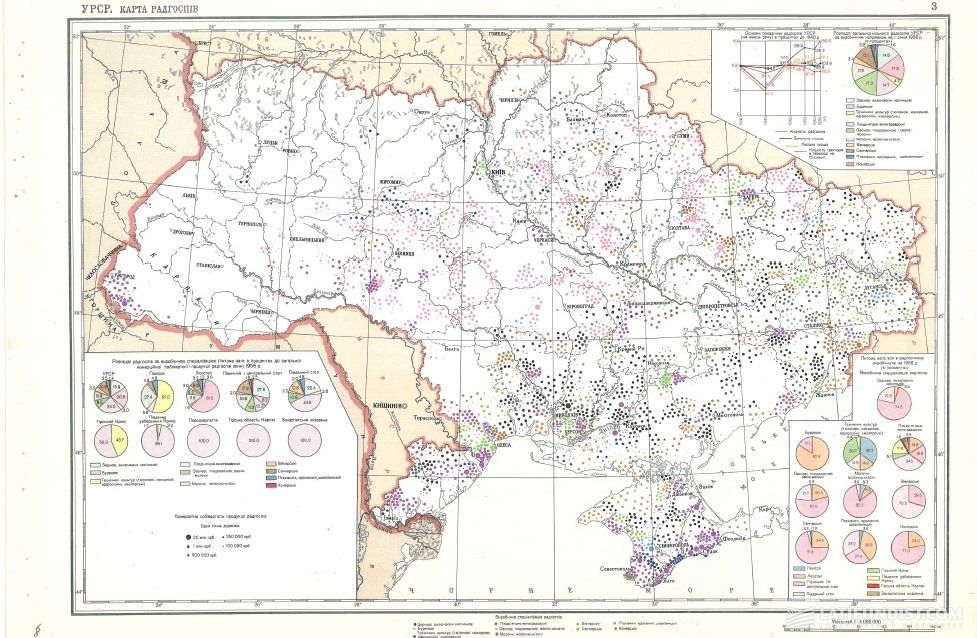
Сегодня на рынке Украины работает более 40 000 сельскохозяйственных предприятий. Для сравнения: в конце 1955 года на территории Украинской ССР было около 15 400 колхозов. Колхозы были еще одним изобретением сталинского режима — первоначально они создавались из имущества, которое отбиралось у зажиточных селян в период коллективизации.
Больше об аграрном секторе Украины 50-х годов можно прочитать в Атласе сельского хозяйства Украинской ССР 1958 года выпуска.

4. Сегодня АПК снова стал ведущей индустрией экономики Украины

В 2014 году доля продукции АПК во внешней торговле Украины достигла 28%, благодаря чемусельское хозяйство стало главным экспортером страны, опередив по объемам дохода от экспорта металлургию. Это означает, что валютные поступления от продажи кукурузы, подсолнечного масла и других товаров оказывают позитивное влияние на  платёжный баланс Украины, и служит поддержкой для нестабильной экономики и даже курса гривны.
Также сельское хозяйство дает 10%  ВВП Украины. В этой сфере работает каждый пятый украинец.

5. Украина — номер один в мире по подсолнечнику

Что касается урожая и экспорта подсолнечника, то в этой сфере равных Украине нет в целом мире. Мы производим 10,5 млн. тонн подсолнуха, а это почти треть всех семечек, произведенных в мире — 27% глобального производства. Еще одно первое место у нас по экспорту подсолнечного масла — 3,3 млн. тонн в год. Это очень много масла!
Специалисты Baker Tilly подсчитали:  если залить все произведенное в Украине подсолнечное масло в бассейны, понадобится аж 1560 олимпийских бассейнов.
Другие позиции Украины на глобальном рынке продовольствия такие: 4-е место по объёму экспорта кукурузы (16,7 млн. тонн). 5-е место по объёму экспорта ячменя (2,3 млн. тонн) и 7-е место по объему производства ячменя (9,1 млн. тонн).
Украина — восьмая в мире по объему производству кукурузы (22,8 млн. тонн/ 2,3%) и экспорту пшеницы (7,8 млн. тонн). По объему производства пшеницы "хлебная корзина Европы" занимает 10 место (22,3 млн. тонн или 2,5% мирового рынка).
6. Площадь украинских чернозёмов равна площади Великобритании
Достижениями сельского хозяйства мы обязаны, в первую очередь, богатому природному ресурсу: необыкновенно благоприятной почве. Большинство стран мира не владеют и десятой частью того, что имеем мы. Совокупная площадь украинских  чернозёмов сопоставима с площадью Великобритании.
Особенно плодотворной является южная и центральная части Украины, где около 50% территории составляет "чистый" чернозем.
7. ...но распоряжаются этими землями в Украине не очень эффективно
Несмотря на наличие чернозема и во многом благоприятный климат, в Украине низкая урожайность: на одном гектаре аграрии  выращивают меньше кукурузы и пшеницы, чем в странах Европы.  
Тому есть много причин. Это и неразвитые технологии, и отсутствие государственной поддержки и нерешенный вопрос с рынком земли. Украина славится значительными объемами экспорта. Но график выше доказывает, что значительное производство зерновых происходит не за счет высокой урожайности, а  за счет огромнейших площадей. 

8. Еще одна проблема: богатые украинские земли деградируют

Одна из основных проблем в агросфере — нерадивое использование самого ценного ресурса. Земли страдают от различных видов деградации:  потери плодородного слоя, эрозии и загрязнения. Эрозии грунта подвержено более половины всех плодородных земель Украины. Такая ситуация наблюдается не только в Украине. Во многих  странах плодородные почвы находятся под угрозой разрушения. Поэтому Продовольственная и сельскохозяйственная организация ООН (FAO) назвала 2015 год Годом почв.

9. Основное направление украинского агробизнеса сегодня — растениеводство  

В 2013 году общий объем производства валовой продукции сельского хозяйства составил 252,9 млрд. грн., и более 70%  — производство растениеводческой продукции. Другими словами,  у нас производят много зерна и мало мяса.  Это позволяет нам экспортировать зерна на сумму более чем 10 млрд. долл., но вынуждает закупать свиное мясо за рубежом. Собственной свинины Украине не хватает. Зато производимого в стране куриного мяса и яиц хватает с головой. Просто факт: мяса птицы в Украине производится в 4 раза больше, чем свинины — 867 тыс. тонн. Крупнейшим производителем курятины является "Мироновский хлебопродукт".

10. Эффективность украинского агробизнеса намного ниже, чем в Европе

Неоднократно поднималась тема об уникальности возможностей украинской земли, прекрасного климата и всё такое. Мы сделали простое сравнение: в странах, чья площадь плодородных земель примерно такая же, как в Украине (Франция, Германия), с/х продукции производится  в 2,5 раза больше. Однако такие высокие показатели объясняются не только меньшей эффективностью украинского АПК, но и большими объемами господдержки европейских фермеров и более высокой стоимостью продукции, произведенной в ЕС. Напоминаем: по размерам территории, Украина является 2-й страной в Европе.

11. ... но Украина все равно производит больше, чем потребляет 


Запомните этот график — он лучше всего объясняет потенциал сельского хозяйства Украины. Все дело в том, что несмотря на определенную неэффективность, Украина производит в 2 раза больше зерна, чем нам нужно. Только несколько стран в мире "съедают" меньше, чем производят. Именно поэтому Украина занимает очень важное место в мировом экспорте сельскохозяйственной продукции: мы экспортируем  около половины зерновой продукции, которую производим. 
12. Урожай 2014 также был отличным
В прошлом году объемы урожая практически не изменились по сравнению с 2012 годом, кроме разве что кукурузы и подсолнуха, по которым показатели все же снизились. Хороший урожай можно объяснить очень благоприятными погодными условиями как в период посевов, так и в период сбора урожая. Ну и, конечно же, многолетним опытом отечественных аграриев.

13. За 10 лет экспорт с/х продукции в Европу вырос в 5 раз

Европейский союз с каждым годом закупает все больше украинской кукурузы, пшеницы и подсолнечного масла. По большей части это сырьё в самых разных его видах. В 2012-2014 годах денежный оборот между Украиной и ЕС перешагнул отметку в 9 млрд. долл. Основным покупателем кукурузы в Европе является Испания (2,3 млн. тонн в год), Италия покупает соевые бобы, Франция — семена рапса и макуху.
С подписанием Соглашения об ассоциации открываются большие возможности для экспорта аграрной продукции в Европу, но из-за требований Европы к качеству продукции украинские производители этими возможностями воспользоваться пока не могут. Большинство выделенных для них экспортных квот остается не использованными. 

14. ...при этом основным покупателем украинской с/х продукции (в основном зерна) в 2014 году стала Азия 

Европа является одним из основных потребителей украинского сырья, но не самым крупным. Азия покупает подсолнечного масла, кукурузы и другой продукции АПК на общую сумму более 5 млрд. долл. в год. Это на миллиард больше, чем покупает у нас Европа.
15. Украина уже давно не "хлебная корзина", а скорее "кукурузный мешок"
Уже несколько лет Украина производит больше кукурузы, чем пшеницы.  Причина таких изменений — перемены в мировом потреблении и производстве. Увеличение спроса со стороны таких гигантов, как Китай и Индия, побудило украинские агрохолдинги уделять больше внимания выращиванию этих зерновых культур, а также подсолнечника, который экспортируют уже в виде подсолнечного масла, поскольку продавать масло значительно выгоднее, чем необработанные семечки.
Кстати, именно поэтому в Министерстве аграрной политики и продовольствия считают поддержку предприятий по переработке с/х сырья важнейшей стратегией развития АПК Украины. Например, из кукурузы можно делать  разные продукты — крахмал, кукурузный сироп, этанол, и при этом зарабатывать на экспорте больше. 

16. Основной экспортный доход Украина получает от продажи кукурузы, пшеницы и подсолнечного масла 

Успешность любого бизнеса определяется не только наличием дохода, но и уровнем его максимизации. В условиях рыночной экономики всегда необходимо создавать конкурентные возможности, с помощью которых можно создавать добавочною стоимость.
Обратите внимание на доход от экспорта кукурузы и подсолнечного масла (отражен в кругах зеленого цвета). А теперь сравните объемы экспорта. Получается, что мы экспортируем масла примерно в 5 раз меньше, чем кукурузы, но получаем сопоставимый доход. Это отражает выгоды экспорта переработанной продукции (подсолнечное масло вместо семечек) по сравнению с экспортом сырья (зерно кукурузы, пшеницы и т.п.). Вот почему важно развивать и поддерживать сферу переработки, о которой говорилось в предыдущем пункте.

17. Большие агрохолдинги более продуктивны, чем фермеры

На сегодня десяти самым крупным агрохолдингам принадлежит около 15% всех пахотных земель Украины. Средняя урожайность на полях любого из этих холдингов, в среднем, в 2 раза выше, чем у мелких предпринимателей. В то же время средние и мелкие фермеры дают работу большинству занятых в сельском хозяйстве селян.
Однако этот слайд отражает не только эффективность агрохолдингов, но и демонстрирует серьезный вызов для социальной политики государства в сфере АПК, поскольку повышение эффективности и дальнейшее укрупнение агрохолдингов будет означать увеличение безработицы в селах и ухудшение социальной ситуации. 
18. Самые крупные в агробизнесе Украины — Кернел, Ukrlandfarming, Нибулон и МХП (по размеру доходов)
Ukrlandfarming во главе с Олегом Бахматюком с каждым годом растет во всех смыслах: постоянное увеличения земельного банка, поглощения других агрофирм, наращивание дохода, увеличение количества специалистов. Холдинг распределил своё влияние по всей территории Украины, но особенная концентрация наблюдается в Сумской и Полтавской областях. Компания имеет достаточно дифференцированный перечень направлений — от растениеводства и животноводства до производства сахара и предоставления техобслуживания. Еще один титан украинского рынка это компания Кернел. Основным ориентиром для холдинга является растениеводство, экспорт зерновых и масличных, а также производство подсолнечного масла. Но такой, казалось бы, узкий профиль дает рекордный доход компании и позволяет быть непревзойденным лидером рынка. 
19. Аннексия Крыма обошлась Украине в -2% в производстве пшеницы и -20% в производстве винограда 
У каждого гражданина нашей страны (да и не только нашей) есть свои аргументы для возвращения Крыма Украине. С точки зрения сельского хозяйства у нас есть потери. Пусть это и не заставит украинцев голодать, но -450 млн. тонн пшеницы все же не мало. А как быть без почти 400 млн. тонн свежих и полезных овощей? И самое важное и больное — минус 20% винограда, а значит, и вина. Более детальную информацию можно узнать на сайте национального агропортала Latifundist.com
20. Перспективы нашего агробизнеса связаны с повышением эффективности, а не ростом населения в мире 
Эта карта иллюстрирует Global Hunger Index. Этот индекс часто приводят в качестве аргумента высокого экспортного потенциала украинской продукции. Так вот, это не аргумент. Если посмотреть на данные по экспорту из пункта 14,  основными покупателями украинской с/х продукции являются богатые страны, а не голодные. Хотя население основного импортера агропродукции Украины — Азии —  растёт,  потребность в кукурузе и подсолнечном масле в странах Азии будет расти только с общим экономическим ростом и увеличением покупательской способности населения.  Что же касается Африки, как самого "голодного" континента, то основной проблемой является бедность. Поэтому страны Центральной Африки  не могут и вряд ли смогут в ближайшее время покупать нашу продукцию в больших объемах. Основными потребителями продукции украинского АПК останутся Египет  и ЮАР.
Так с чем связаны перспективы украинского сельского хозяйства? Читайте: "Майбутнє українського агробізнесу забезпечить ефективний менеджмент, а не чорноземи"
21. ...а также с развитием животноводства и пищевой переработки 
Одна из основных проблем украинского экспорта — почти полное отсутствие продуктов животноводства. Естественно маленькая доля в экспорте в первую очередь обусловлена низким уровнем развития отрасли в целом. При этом мы не можем даже обеспечить внутреннюю нашу  потребность в продуктах животноводства — закупаем в других странах.  

22. Наглядная демонстрация проблем сырьевой экономики: в аграрной стране население тратит на еду половину доходов!

Уровень расходов на продукты питания — важный экономический показатель развития страны в целом, а также уровня жизни населения. Украинцы тратят больше половины своих доходов на продукты питания — это наихудший показатель в Европе. То есть жители аграрной страны вынуждены работать только для того, чтобы покушать.
Это одно из проявлений сырьевой экономики, когда страна не развивается и живет за счет продажи зарубеж сырья. Поэтому государственная поддержка сельского хозяйства должна заключаться и в развитии экспорта сырья, и в развитии перерабатывающей сферы производства, чтобы позволит продавать зарубеж продукцию с большей добавленной стоимостью, создаст дополнительные рабочие места и повысит уровень жизни в стране. 
__________________
При подготовке этой статьи мы использовали данные Министерства аграрной политики и продовольствия, Государственного комитета статистики Украины, FAO и расчеты международной аудиторской компании Baker Tilly.

воскресенье, 8 февраля 2015 г.

B2B Customer Experience: Do This, Not That

business to business customer experience management differences

by 

Is business-to-business customer experience management (B2B CXM) a watered-down or a souped-up version of consumer experience management? Does the answer differ when the business you’re selling to is a manufacturer versus a professional services company? Or when your company provides specialized industrial goods, ingredients or components for customers’ products, enterprise software versus desktop software, or business services? All these questions are worth exploring. They’re important questions because customer scenarios differ in each case. Ideally, how you manage customer experience custom-fits your customers’ needs, preferences, and circumstances.
This series of monthly B2B CX articles explores the nuances of business customer experience. The questions above will be addressed in future installments.
Universal to most B2B CXM scenarios is the existence of a “village” of people who influence B2B buying decisions. This single fact means a lot. If the purpose of customer surveys is to accurately monitor customers’ likelihood of rebuying, then you must gain an understanding of each influencer’s expectations and sentiment.
A logical follow-up to this is the need to integrate the viewpoints of the “village” to paint a realistic picture. In consumer situations, there are usually only a couple of viewpoints to integrate for any purchase: husband and wife, parent and child. But for B2B situations, you may be grappling with integrating the views of the user, purchasing agent, plant manager, and gatekeepers for IT, safety, facilities, and quality, among others.
And another commonality among many B2B relationships is extensive post-purchase interaction. This may be related to a complicated deployment such as enterprise software, or peer-to-peer, such as engineers from the supplier and customer companies meeting to work out usage details, or a customer appointee who interfaces with multiple locations of the supplier company in a single morning.
Here are 3 keys to getting B2B customer experience management right: capture the whole buying decision equation, integrate influencers’ inputs to paint an accurate picture, and ensure post-purchase customer experience consistency.
1) Capture the Whole Buying Decision Equation: Why try to tie CX to financials without fully understanding who’s driving what?


DO THIS: Identify all parties within a customer account with the power to kill a buying decision. Characterize each party’s expectations and design your customer-listening portfolio to keep a radar on their sentiment. Quantify the consequences of meeting or missing each party’s expectations.
NOT THAT: Assuming that whoever signs the contract or transacts with your service organization is a spokesperson for their company, or that a series of transactions represents the customer experience that can be reasonably tied to bookings.
2) Integrate Influencers’ Inputs to Paint an Accurate Picture: Simplification of the complex picture is essential for tackling the issues and formulating better strategies to capitalize on opportunities.
DO THIS: Weight and nest the parties’ inputs for more realistic linkages to bookings. Make your customer intelligence reporting compelling: consider show the parties’ interests through flow-charting, cause-and-effect diagramming, activity network diagramming, or interrelationship diagraphs. Make sure action plans reflect inputs from all influencers.
NOT THAT: Assuming that averages and bar charts convey what’s needed to be actionable and effective. Don’t ignore the opportunity to get valuable insights from your dedicated sales team. And don’t let the account teams obscure insights that can help the rest of the company help them.
3) Ensure Post-purchase Customer Experience Consistency: Why work so hard to manage perceptions but ignore these vital touchpoints?
DO THIS: Make it easy to capture informal comments. Then stream informal feedback to relevant groups throughout your company. Establish cadence & methodology for originators to prevent issue recurrence. Motivate actions and follow-through on informal inputs. Set the stage for streamlined re-purchase decisions: share actions and progress to proactively influence rebuying.
NOT THAT: Assuming that inconsistencies will naturally work themselves out, or aren’t important to building trust and relationship strength. Waiting to send a survey when you’re already getting a goldmine of insights that you can work on right away to be more proactive in influencing repurchase decisions.
B2B CXM has parallels with consumer experience management, but there are definite realities in B2B CXM that should be addressed in order to make the most of your efforts and investments. Experiment with these 3 B2B “musts”, or better yet, design them into your B2B customer experience management from the beginning. As the graphics above show, you’re likely to stand out from the crowd in your industry in doing so, and these methods may be an important customer experience differentiator for your company.
Note: The concept of "Do This, Not That" is borrowed from the popular book "Eat This, Not That", where the weaknesses of common practices and myths are brought to light and sensible replacements are recommended.

суббота, 7 февраля 2015 г.

Keeping Customers Happy Keeps You in Business

keeping_customers_happy_infographic

How neuroscience can help to build your brand


Understanding the implications of what scientists are teaching us about System 1 and System 2 thinking can help marketers implement more effective plans, writes Vickey Bullen, chief executive of Coley Porter Bell.

Over the past year or so, I have become increasingly interested in the latest learnings from neuroscience, in particular System 1 and System 2 thinking. Not only does it give a scientific basis to what many of us have instinctively felt about how people make decisions and choices about life and brands, but also, more importantly, that understanding can help us do our jobs better.

Rapid-response and logical

Neuroscience has shown that most of our decision-making is automatic, intuitive and instinctive – and it’s made in the System 1, ‘rapid-response’ part of our brains. After that initial ‘autopilot’ response, we then rationalise those decisions in the System 2 part of our brains – the reflective and logical section.
It’s why we desire the sleek minimalism of an Apple product or the elegant lines of a BMW first, then convince ourselves it’s because of the interface or engineering.
And so, as brand owners, brand strategists or brand designers, we need to create brands that connect with System 1 (that seduce the subconscious), while also talking to System 2 (convincing the conscious). That all makes a lot of sense, but the question is, how do you actually do it? As in the field of behavioural economics there are ‘rules’ that you can look to for guidance.

Here are three that you might consider as you define and create your brands:

Rule 1 System 1 learns by association.Throughout our lives we build association networks in our brains – we learn how to decode symbols and visuals and unlock mental concepts or meaning from them. For example, see a pair of people holding hands and we immediately understand that this is an image of protection and security – we learned that in childhood when our parents held our hands to keep us safe.
Understand cultural codes. For brand-owners and designers, this means a need to understand what cultural codes, symbols and visuals will unlock the right meaning. Take the design of upmarket conserve brand Bonne Maman. It unlocks the associations of homemade with its gingham lids and simple black-and-white labels. Similarly, our work for coffee brand Nescafé Azera aimed to create out-of-home coffee cues with an identity reminiscent of enamel-badged Italian coffee machines.
Associations can change over time. Keep up with evolving visual trends. The health category traditionally used a lot of pale blues and whites and a pared-back aesthetic – a visual language of deprivation. New attitudes toward a more positive, holistic approach to health have created a new set of visual codes – rich, vibrant colours, as seen in the likes of Waitrose’s Love Life range and the Ella’s Kitchen brand.
Rule 2 System 1 is goal-oriented. It directs our attention to that which looks most likely to fulfil our goals. So, we need to understand the design cues associated with that fulfilment of particular goals or needs – look at segmentation studies through a visual lens. What visual codes will appeal to that segment? Get it wrong and your visual identity will, at best, be at dissonance with other communications, or, at worst, repel your target audience.
Rule 3 Use the learnings from neuroscience in the execution of brands, but also consider it in the definition of them in the first place. Most strategic processes are inherently biased toward System 2. Lots of words, research, brand models – all ‘heavy lifting’ thinking for the brain.
Perhaps we need to embrace new ways of developing strategy that embrace the use of gut, intuition and our System 1, and force us to use it. One way to do that is by temporarily putting System 2 words to one side and working with visuals – the dominant language of System 1. Create strategy visually and maybe you will get to better words – better brand definitions that incorporate System 1 and System 2 cues.
These are just three ways of applying the lessons that neuroscience has taught us regarding decision-making, and there are many more. Just knowing about neuroscience doesn’t help us to do a better job – the key is how we apply it.

пятница, 6 февраля 2015 г.

Skip the Boring Business Plan. Focus on This Strategy Instead


The concept of starting a business without a plan would send anyone running -- and for good reason. Every great business begins with a plan that outlines measurable goals and the methods for achieving them. Plans, done correctly, can be a great roadmap.
The real question is how detailed does your plan have to be.
Business plans serve a very specific purpose: to demonstrate where you currently are and where you would like to be. In simple terms, how you will get from point A to point B. The problem is that as with any startup, you have very little information as to the best way to reach Point B. Startups don’t even know who their customers are or what their product should be.
“Planning and forecasting are only accurate when based on a long, stable operating history and a relatively static environment,” said Eric Ries in the introduction for The Lean Startup. “Startups have neither.”
As a serial entrepreneur, I’ve come to appreciate the unpredictability of running a startup. It’s a fascinating ride to watch different iterations of your product strike new chords with an expanding audience, and I’ve come away from these experiences with a few insights into what should go into the planning phase of starting a business.

Business plans are becoming increasingly irrelevant.

Customers have never cared about your business plans, and nowadays, investors are increasingly becoming less fond of them.
Take Y Combinator, for example. Y Combinator is a Silicon Valley-based accelerator that has helped fund over 500 companies in its nine-year history. Their portfolio includes giants like Airbnb, Reddit and Dropbox. Getting into the Y Combinator is a competitive process, but one thing you absolutely don’t need to get in is a business plan. They don’t ever read them.
Sam Altman, the president at Y Combinator, explained this logic in an interview with Russell Roberts on the EconTalk podcast.
“At the stage that we are operating at, (a business plan) is irrelevant,” Altman said. “We would rather them spend the time working on their product, talking to users. What we care about is: Have you built a product? Have you spoken to users? Can we see that?”

Map out your business model with a 'Lean Canvas.'

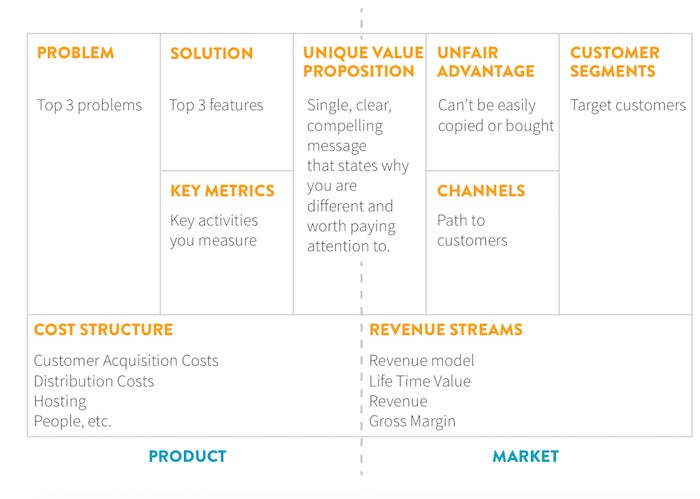
Written business plans take a lot of time to create and don’t allow the flexibility you need as your business grows. However, it’s still important to map out your business model and document your hypotheses, which you can do effectively with a "Lean Canvas."
Created by Ash Maurya and adabted by Alexander Osterwalder, a lean canvas is an actionable and entrepreneur-focused business plan. It focuses on problems, solutions, key metrics and competitive advantages. With hundreds of different things you could be doing, a Lean Canvas helps you hone in on the one or two things that should take top priority.
Here is a sample of a Lean Canvas:
Skip the Boring Business Plan. Focus on This Strategy Instead.
This model captures the same level of information as a traditional business plan, but in a single page. It also gives you much more flexibility to switch to a plan B if plan A doesn’t work out, allowing you to transition to a new approach without running out of resources.
Being able to boil down the essentials of your business model onto a single page can pay huge dividends. When you meet with customers or potential investors, you won’t have much time to describe your entire vision. If you can describe your customer's problems clearly and succinctly, you can get to the heart of why your solution fits.

So how do you start?

Start by setting a timer for 15 minutes and filling out the sample Lean Canvas with as much information as you can. This will help you identify what you know and don’t know about your business. Don’t be afraid to be brutally honest with yourself, and you can even leave certain areas blank.
After you complete the canvas, you can quickly identify the riskiest parts of your business. At this point, you can begin to build experiments to gather data about those areas to test your assumptions. These experiments will test the waters of some of the most fundamental aspects of your plan. For example, let’s say you identified social media as the optimal channel for reaching and converting your customers. After a few weeks of test runs, however, you may learn that your audience is not as socially active as you originally projected. Considering this was your main plan-of-action for reaching your customer base, you’ll have to reassess your understanding of who your market is and where they can be reached.
 
After about a month of experimenting, you will hopefully have learned enough to be able to return to your Lean Canvas and update it based on your new findings. And, if you’re like most startups, you won’t get it right the first, second, or probably even third time. Reevaluating the main components of a given business model is not uncommon in the early years of many major corporations.
 
As a startup, you are in a race to deliver customer value. Sinking time into writing out a business plan -- a plan that you probably won’t be able to stick to -- can be a tremendous waste of time. You can get all of the benefits of a business plan on one page, and this will help you discover the two or three things that matter most today.
by 
CACHE MERRILL
CONTRIBUTOR
Founder and CTO of Zibtek