пятница, 6 февраля 2015 г.

Skip the Boring Business Plan. Focus on This Strategy Instead


The concept of starting a business without a plan would send anyone running -- and for good reason. Every great business begins with a plan that outlines measurable goals and the methods for achieving them. Plans, done correctly, can be a great roadmap.
The real question is how detailed does your plan have to be.
Business plans serve a very specific purpose: to demonstrate where you currently are and where you would like to be. In simple terms, how you will get from point A to point B. The problem is that as with any startup, you have very little information as to the best way to reach Point B. Startups don’t even know who their customers are or what their product should be.
“Planning and forecasting are only accurate when based on a long, stable operating history and a relatively static environment,” said Eric Ries in the introduction for The Lean Startup. “Startups have neither.”
As a serial entrepreneur, I’ve come to appreciate the unpredictability of running a startup. It’s a fascinating ride to watch different iterations of your product strike new chords with an expanding audience, and I’ve come away from these experiences with a few insights into what should go into the planning phase of starting a business.

Business plans are becoming increasingly irrelevant.

Customers have never cared about your business plans, and nowadays, investors are increasingly becoming less fond of them.
Take Y Combinator, for example. Y Combinator is a Silicon Valley-based accelerator that has helped fund over 500 companies in its nine-year history. Their portfolio includes giants like Airbnb, Reddit and Dropbox. Getting into the Y Combinator is a competitive process, but one thing you absolutely don’t need to get in is a business plan. They don’t ever read them.
Sam Altman, the president at Y Combinator, explained this logic in an interview with Russell Roberts on the EconTalk podcast.
“At the stage that we are operating at, (a business plan) is irrelevant,” Altman said. “We would rather them spend the time working on their product, talking to users. What we care about is: Have you built a product? Have you spoken to users? Can we see that?”

Map out your business model with a 'Lean Canvas.'

Written business plans take a lot of time to create and don’t allow the flexibility you need as your business grows. However, it’s still important to map out your business model and document your hypotheses, which you can do effectively with a "Lean Canvas."
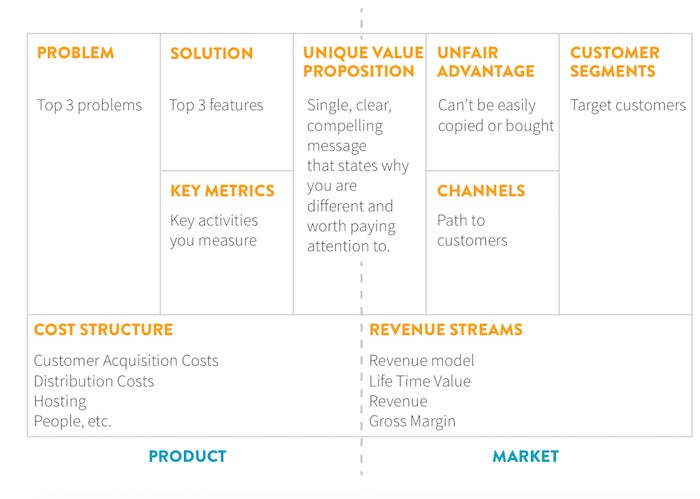
Created by Ash Maurya and adabted by Alexander Osterwalder, a lean canvas is an actionable and entrepreneur-focused business plan. It focuses on problems, solutions, key metrics and competitive advantages. With hundreds of different things you could be doing, a Lean Canvas helps you hone in on the one or two things that should take top priority.
Here is a sample of a Lean Canvas:
Skip the Boring Business Plan. Focus on This Strategy Instead.
This model captures the same level of information as a traditional business plan, but in a single page. It also gives you much more flexibility to switch to a plan B if plan A doesn’t work out, allowing you to transition to a new approach without running out of resources.
Being able to boil down the essentials of your business model onto a single page can pay huge dividends. When you meet with customers or potential investors, you won’t have much time to describe your entire vision. If you can describe your customer's problems clearly and succinctly, you can get to the heart of why your solution fits.

So how do you start?

Start by setting a timer for 15 minutes and filling out the sample Lean Canvas with as much information as you can. This will help you identify what you know and don’t know about your business. Don’t be afraid to be brutally honest with yourself, and you can even leave certain areas blank.
After you complete the canvas, you can quickly identify the riskiest parts of your business. At this point, you can begin to build experiments to gather data about those areas to test your assumptions. These experiments will test the waters of some of the most fundamental aspects of your plan. For example, let’s say you identified social media as the optimal channel for reaching and converting your customers. After a few weeks of test runs, however, you may learn that your audience is not as socially active as you originally projected. Considering this was your main plan-of-action for reaching your customer base, you’ll have to reassess your understanding of who your market is and where they can be reached.
 
After about a month of experimenting, you will hopefully have learned enough to be able to return to your Lean Canvas and update it based on your new findings. And, if you’re like most startups, you won’t get it right the first, second, or probably even third time. Reevaluating the main components of a given business model is not uncommon in the early years of many major corporations.
 
As a startup, you are in a race to deliver customer value. Sinking time into writing out a business plan -- a plan that you probably won’t be able to stick to -- can be a tremendous waste of time. You can get all of the benefits of a business plan on one page, and this will help you discover the two or three things that matter most today.
by 
CACHE MERRILL
CONTRIBUTOR
Founder and CTO of Zibtek

10 Mindsets That Will Radically Improve Your Business

10 Mindsets That Will Radically Improve Your Business


Success is something all career-driven individuals desire yet it eludes many people -- at least at the levels desired. Why are some businesspeople successful and others not?
It has everything to do with habits, beliefs, passion, flexibility and attitude.
Often there's nothing really different between one entrepreneur and another in terms of ability, as each person can do whatever he or she wants. What it all comes down to is having the frame of mind to set practical habits and keep a balance between attachment and commitment and letting things happen. 
Here are 10 mindsets for success:

1. Choose courage over fear.

To be successful, you have to have courage. And to become courageous, do courageous things. Much of being successful is about going beyond what you think you're capable of -- venturing into the unknown. Whether you fail or succeed, you will learn and grow. 
Growth, in and of itself, means attaining a level of success whether it came from success or failure.

2. Believe in yourself.

Attitude is everything. A negative attitude decreases success and a positive attitude creates success. Without that belief in yourself, you'll lack a path to success. 
Success is something that's created. It's not something that merely "happens.”
When you firmly believe in yourself, you can achieve virtually anything: It's within this belief that you'll find the power to create the resilience and fortitude needed to keep going when things get tough.

3. Choose good company.

Whom you surround yourself with is among the most important choices you'll make as you climb up the business ladder. Negativity is contagious and if work groups, especially bosses, are negative, there will be a ceiling to your success.
To reach the goals you desire, be willing to change bosses if necessary. Or if you're the boss, rid your team of toxic people immediately.
It only takes one toxic person to destroy the morale of an entire campaign. Further, when you surround yourself with other successful, goal-oriented individuals, you can learn from them and take on some of their habits to add to your own as you proceed along your road to success.

4. Adopt self-chosen goals.

Knowing and being clear about where you're headed in business is something that must come from within. When your goals selected by you, you're more motivated to achieve them.
That's because by achieving these goals, you attain a new desired piece of yourself. When your goals arise from your instigation, they carry a deeper meaning and confer a greater impact on your identity.
Each self-selected goal realized adds a depth and an internal expansion to you as a person. Personal expansion is just one of the great gifts to come from succeeding in your business goals.

5. Have a purpose and a vision.

Visualization is powerful because actions follow thoughts. A great technique for nurturing your vision and purpose is to make your goals visual. Some people use vision boards; others opt for treasure maps. And still others set goals identifying specific dates for their achievement.
Whatever works best is a matter for the individual to figure out.
I believe that anything that's written down is more likely to be achieved than visions kept only in the head. When you make your purpose visual, you make it real. When you keep them in your mind, they remain wishes.

6. Accept the challenge.

There are few easy paths up a mountain and often they're hard to find. Challenge will be an essential piece in any type of success in business.
And challenge is what creates your growth along the journey. Each challenge obstructing your path provides you with the chance to create a more defined direction toward attaining your dream vendors, customers, managers, employees -- and numbers. For this reason, bless each challenge. Each one is a compass directing you toward new business leads, circumstances and opportunities.

7. Be discerning.

Selectivity creates success. You must think deeply and intelligently about the bigger picture and what it is you need for each step along the way to continue articulating and executing your business goals.
Mindfulness means being aware of all angles and staying sharply in touch with the present so that you do not have to clean up mistakes in the future.
Be discerning of group dynamics: which person is the best at what job, which customers or deals will take you the furthest and what it is that each moment is calling on you to do or change to be the most efficient.
That's how selectivity offers you the pursuit of success.

8. Be willing to take risks.

There are no guarantees on any path to success in life or business. The unknown is always looming. Therefore, risk and education are often the mechanisms necessary for knowing more clearly if you're on the right path.
If you're afraid to risk, you will put limits on your success and stay where you're comfortable. You cannot get what you want if you don't risk rejection and go for what you desire.

9. Do what you love.

You're more likely to succeed in business when you're invested in your passion and making your career fit your personality. There is a way to find passion about anything and everything you do in life.
You may not love every part of your job but tolerating discomforts by looking at the bigger picture makes your investment of time and energy worthwhile.
Be willing to love and find purpose in all aspects of what your business requires, commit to it and see what you're doing as being a benefit to others. When you love the business you're in, there is nothing that can keep you from wanting to work at it, nurture it and make it grow.

10. Gratitude.

When you see life and career in terms of the lack in what you have achieved, you cannot drive your business up the ladder of success. Then negativity is impeding your progress.
You must look at all you have and realize how great what you have is as compared to the situation of many others.
When you have this attitude, you stop suffering and complaining about the small stuff. On each receipt you pay out, write thank you. That's not only to thank the person, event, vendor or customer for what's provided you but also to give a private thanks acknowledging that you have the abundance necessary to pay for the service, product or event.
Habits coupled with flexibility provide you with a path to success. Success is fluid and so rigidity will stand in its way.
Developing these mindsets give you a compass to navigate the ever-changing tides on the way to business and financial goals. These mindsets allow openness and flexibility while also providing you precise direction.

воскресенье, 1 февраля 2015 г.

Лидогенерация в B2B-секторе: какие лиды самые ценные?


Не секрет, что от качества полученного лида во многом зависит возможность или невозможность его конвертации в клиента компании. Этот пост посвящен одному из опросов Business.com, проведенному в мае 2013 года. В качестве опрошенных выступили 500 респондентов, являющихся клиентами этой платформы. В их числе были не только маркетологи, но и владельцы компаний, а также представители отделов продаж. Исследование проводилось в рамках B2B-сегмента на уровне предприятий малого и среднего бизнеса (SMB). Держа в уме эти исходные данные, можно проанализировать некоторые полученные результаты.
Итак, согласно недавно опубликованному отчету, большинство маркетологов (51%) B2B-сектора, генерирующие лиды, хотели бы (но зачастую не имеют такой возможности) в качестве отправной точки получать информацию о том, сколько времени проходит между получением лида (контакта) и желаемым окончательным конверсионным действием.
Вторым по важности показателем лида в этой связи был назван размер компании клиента, исходя из количества ее работников: 31% опрошенных указали, что эта информация крайне важна. Часть респондентов также высказали заинтересованность в наличии данных еще по 2 важным по их мнению пунктам: 29% хотели бы знать сферу деятельности клиента и — 20% иметь информацию о его должности и полномочиях.
Что еще хотели бы знать маркетологи о своих В2В-лидах
Крайне важноВажноВозможно, важноМаловажноВообще не важноНе ответили
Время совершения покупки51.3%31.3%10.0%2.5%5.0%0.0%
Размер компании (исходя из количества работников)30.5%20.7%30.5%9.8%8.5%0.0%
Сфера деятельности29.1%22.8%22.8%15.2%10.1%0.0%
Наименование должности представителя клиента20.3%27.8%29.1%8.9%12.7%1.3%
Размер компании (исходя из дохода)18.8%22.5%27.5%11.3%16.3%3.8%
Должностные обязанности представителя клиента17.3%25.9%34.6%7.4%12.3%2.5%
Ниже представлено еще несколько ключевых позиций, выявленных в ходе опроса 500 респондентов, представляющих сферу среднего и малого бизнеса и регулярно заказывающих платные услуги по лидогенерации.
Опрошенные специалисты и владельцы компаний в целом проявили достаточно высокий интерес к контент-маркетингу как к одному из действенных способов лидогенерации. Наибольшую ценность, по мнению респондентов, представляют лиды полученные посредством применения следующих мероприятий:
  • 51% опрошенных сказали, что лиды, оставленные в момент загрузки официальных документов, описывающих компанию, услугу или товар (whitepapers), имеют для них наибольшую ценность;
  • 34% респондентов в разряд наиболее ценных лидов отнесли контакты, сгенерированные при регистрации потенциального клиента в качестве участника бесплатных вебинаров, рассказывающих о заинтересовавших их компаниях или услугах.
Насколько важны лиды, оставленные в момент загрузки WhitePapers
Крайне важно25.3%
Важно25.3%
Возможно, это важно10.1%
Маловажно20.3%
Вообще не важно19.0%
Насколько важны лиды, сгенерированные при регистрации участников бесплатных вебинаров
Крайне важно17.7%
Важно16.5%
Возможно, это важно26.6%
Маловажно15.2%
Вообще не важно24.1%
Также опрошенные достаточно высоко оценили свою заинтересованность в получении контактов, полученных посредством рассылок (в сумме 38% респондентов сказали, что такие лиды важны/очень важны для них); ценность лидов от видеоконтента и обучающих кейсов признали важными/очень важными 35% и 38% соответственно.
Степень заинтересованности в лидах, полученных от применения других видов контент-маркетинга
Крайне важноВажноВозможно, важноМаловажноВообще не важноНе ответили
Видео-контент14.1%20.5%21.8%20.5%17.9%5.1%
Рассылки14.5%23.7%26.3%14.5%18.4%2.6%
Обучающие кейсы15.6%18.2%32.5%16.9%15.6%1.3%
Описания товаров/услуг14.3%20.8%27.3%15.6%19.5%2.6%
Интерактивные демо-версии продуктов15.6%15.6%27.3%18.2%19.5%3.9%
Рейтинги лидов
Кроме упомянутых данных, достаточно интересными являются следующие данные, полученные в ходе опроса:
  • 42% участников опроса проявили особый интерес к стратегии незамедлительного контакта с лидом после его получения;
  • 60% опрошенных указали, что хотели бы получать информацию о рейтинге лидов (lead scoring), характеризующем степень их готовности к окончательной конвертации.
Итак, если вы работаете в сфере B2B-продаж, и ваш бизнес относится к разряду среднего или малого, берите на вооружение результаты приведенного исследования.
Источник: LPgenerator, marketingprofs.com

Наиболее эффективные методы лидогенерации B2B-маркетинга


В ходе недавно завершившего исследования, охватившего 423 практикующих B2B-маркетолога, Аяз Нанджи (Ayaz Nanji), специалист по маркетинговым стратегиям, выяснил у респондентов их мнение по поводу различных методов лидогенерации.
Оказалось, что согласно мнению опрошенной аудитории лучшими методами генерации лидов для отрасли B2B считаются техники исходящего маркетинга (телемаркетинг, виртуальные/удаленные продажи), эвенты («событийный», он же «эвентуальный маркетинг» — выставки, конференции, вебинары и т. д.), «классический» web-маркетинг ( рассылки, поисковой маркетинг и блоги).
С другой стороны, B2B-маркетологи крайне скептически относятся к социальным медиа, оценивая стратегии социального маркетинга как наименее эффективные в деле генерации лидов. Продемонстрировавшая лучшие результаты по итогам опроса социальная сеть LinkedIn едва-едва пересекла границы квартили (1/4 части) худших методов лидогенерации для B2B.
Ниже мы приводим диаграммы и графики, наглядно иллюстрирующие основные тезисы упомянутого доклада. Похоже на то, что опрошенные участники исследования явно относятся к числу крепких, солидных профессионалов B2B-решений: 57% из них имеет в своем распоряжении рекламные бюджеты не менее $500 000.
Заметим однако, что наличием больших денег в отрасли, по-видимому, только и объясняется большая популярность затратного исходящего маркетинга, которому мы со своей стороны противопоставляем более современную и эффективную концепцию входящего маркетинга (Inbound Marketing).
Соотношение эффективности и распространенности методов лидогенерации для B2B-компаний
Наиболее распространенные методы генерации лидов
Веб-сайты компаний, email-маркетинг и торговые выставки — вот лучшие источники лидов для B2B-сектора.
Методы лидогенерации, используемые в B2B
Топ-14 целей, задач и проблем B2B-маркетолога
Генерация новых лидов и повышение их квалификации (качества) — вот крупнейшая проблема, стоящая перед B2B-маркетологами.
ТОП-14 задач и проблем B2B-маркетолога
Источник: LPgenerator